Team Drama Is Costing You, Both Your Productivity & Your Sanity
Gossip, scorekeeping, eye-rolling, and the "meeting after the meeting" aren't just interpersonal noise. The research says they're destroying your team’s productivity & bottom line, and most leaders are making it worse.
There is a moment most managers know well. An employee closes the office door, lowers their voice, and begins describing a problem with a coworker. The manager listens, nods, and by the time the conversation ends, nothing has been resolved, but both people feel vaguely complicit in something they can't quite name. That moment, repeated daily across organizations, is what researchers call a relationship conflict event. Collectively, those moments are hemorrhaging your organization's capacity to function.
A recent conversation with leadership expert, Joe Mull, author of the book No More Team Drama, got me feeling inspired, and I dug into the research on workplace drama. What I found was sobering. The gossip, infighting, scorekeeping, and avoidance patterns we tend to dismiss as interpersonal noise are not a soft problem. They're a hard business problem with a real & measurable cost. Unlike most operational failures, they tend to metastasize quietly, showing up as mysterious rework, delayed projects, and unexplained attrition long before anyone identifies the real cause.

Ai generated image
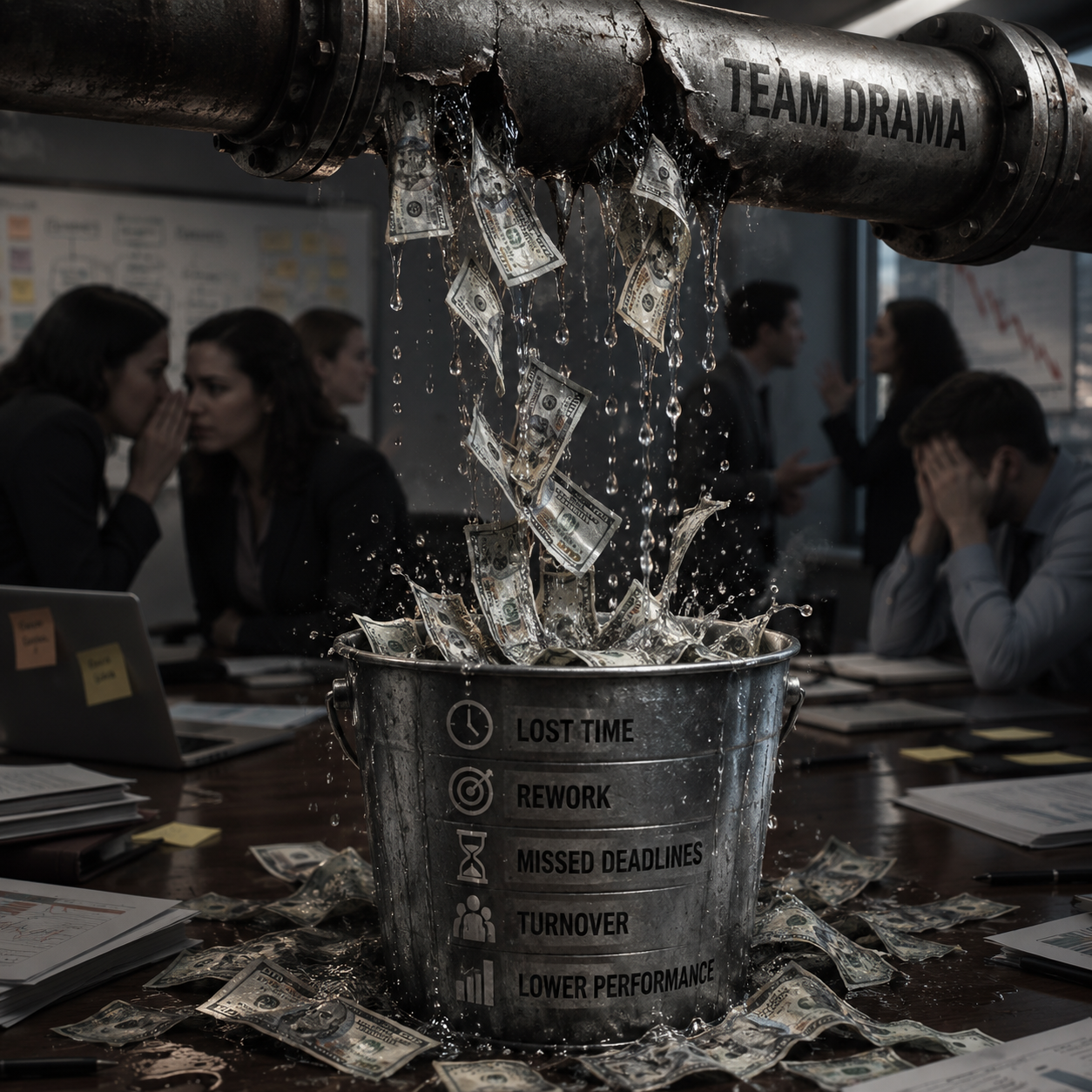
Team drama has a dollar amount.
U.S. organizations lose an estimated $359 billion annually in productivity to workplace conflict (CPP Global). The average employee spends 2.8 hours per week managing or navigating it. That's not background noise, that's a line item.
And it's more common than you'd think. Research from CIPD and Acas finds that 85% of employees at all levels experience workplace conflict to some degree. If you're a manager who thinks your team is the exception, the data says you're probably wrong.
But not all conflict is the problem. This is the part most managers get wrong. Organizational psychologists distinguish between task conflict — disagreement about ideas and priorities — and relationship conflict, which is the personal friction, disrespect, and interpersonal tension that actually tanks performance. Healthy debate improves decisions. Drama does the opposite. The goal isn't a conflict-free team. It's a team that disagrees well.
Why drama spreads — and why it sticks

Ai generated image
Drama feels rewarding in the moment. Psychiatrist Stephen Karpman's Drama Triangle describes how people cycle through three roles: victim, rescuer, and persecutor. Each role delivers a short-term emotional payoff — validation, moral authority, or released frustration. That's why venting to a coworker about a third person feels good even though it solves nothing. It's a dopamine hit dressed up as problem-solving.
Most of us know better, but we don't do better. This is what researchers call the Knowing-Doing Gap. Direct communication is objectively superior to gossip. We know that. But avoiding a hard conversation feels safer than having it, so we choose the side channel instead.
Avoidance doesn't make conflict disappear. It relocates it. What starts as a small friction point gets pushed underground, where it grows into resentment, workarounds, and duplicated effort. By the time it surfaces in your metrics, as rework, missed deadlines, or someone's resignation, it's already expensive.
What it's actually costing your team
Ai generated image
The productivity hit is real and measurable. Research from De Dreu and Weingart (2003) found that relationship conflict consistently lowers team performance and member satisfaction across dozens of studies. It's one of the most replicated findings in organizational psychology.
Incivility is not trivial. A randomized trial published in Pediatrics (Riskin et al., 2015) found that even mild rude comments (not harassment, just dismissiveness) significantly impaired medical team performance. If rudeness degrades performance in high-stakes surgical settings, it's doing the same thing in your project meetings.
Psychological safety is what determines the outcome. Amy Edmondson's research, later validated by Google's Project Aristotle, identified psychological safety as the single most important factor in team performance. When people feel safe to surface problems early, conflict gets addressed before it metastasizes. When they don't, it goes underground, and underground is where drama lives.

AI generated image
What to do about it: your action plan
Start with yourself. Before you complain to a peer about a coworker, ask: am I processing this, or am I venting? Processing means talking with someone to figure out how to handle a situation directly. Venting means talking about someone to get validation without intending to act. Processing is useful. Venting just spreads the problem.
Assume good intent, deliberately. When something bothers you, ask yourself: "What would make a reasonable person act this way?" They might be dealing with a personal crisis, an unclear process, or a competing priority you don't know about. This isn't naive, it's strategic. It keeps you out of the Drama Triangle and keeps your thinking cleaner.
Have the direct conversation. The research is clear that avoidance converts small disagreements into large, expensive ones. The conversation you're dreading is almost always shorter and less catastrophic than the version you've been rehearsing in your head. Start with impact, not accusation: "When X happened, the effect on my work was Y. Can we talk about it?"
If you're a manager, stop playing firefighter. Every time you resolve an interpersonal conflict on your team's behalf, you train them to bring drama to you instead of resolving it directly. When an employee comes to you with a complaint, ask one question before you do anything else: "Are you asking me to help you fix this, or do you need to vent for a minute?" Then act accordingly. Either give them a bounded time to vent and redirect, or coach them through the direct conversation they need to have themselves.
Set explicit team norms. Research consistently shows that working agreements (co-created, explicit rules for how a team handles disagreement and escalation) are one of the fastest ways to reduce ambiguous friction. Something as simple as, "if I have an issue with something you did, my first move is to talk to you directly, not go around you," changes the behavioral default. Write it down. Agree to it as a group.
Know when the problem is structural, not interpersonal. A lot of what looks like personality conflict is actually process failure in disguise. It’s unclear roles, ambiguous ownership, or inconsistent communication norms. Before you assume the drama is about the people, ask whether there's a structural fix that would make the conflict less likely to happen in the first place.
The Bottom Line
Drama is not something that happens to your team. It's a byproduct of what your team permits, and what you, as a manager or individual contributor, choose to do when you feel the pull toward the side channel instead of the direct conversation.
The organizations that handle this well don't have fewer disagreements. They have better ones. That's the whole game.
Subscribe if you don’t already! Get these nuggets of knowledge in your email automatically so you don’t have to go looking for them!

I’m Brian. At age 4, I was diagnosed with insulin dependent (type 1) diabetes and told that my life was going to be 10-20 years shorter than everyone else. As a kid I took time for granted, but now as an adult, time is the most precious thing that I have. After spending a career hands-on in the trenches as a leader at all levels, I now train Productivity Gladiators to level up their careers. Graduates wield superpowers in time management, practical leadership, communication, & productivity. If what you’ve seen here intrigues you, reach out, let’s chat!
“Time is the currency of your life, spend it wisely.”